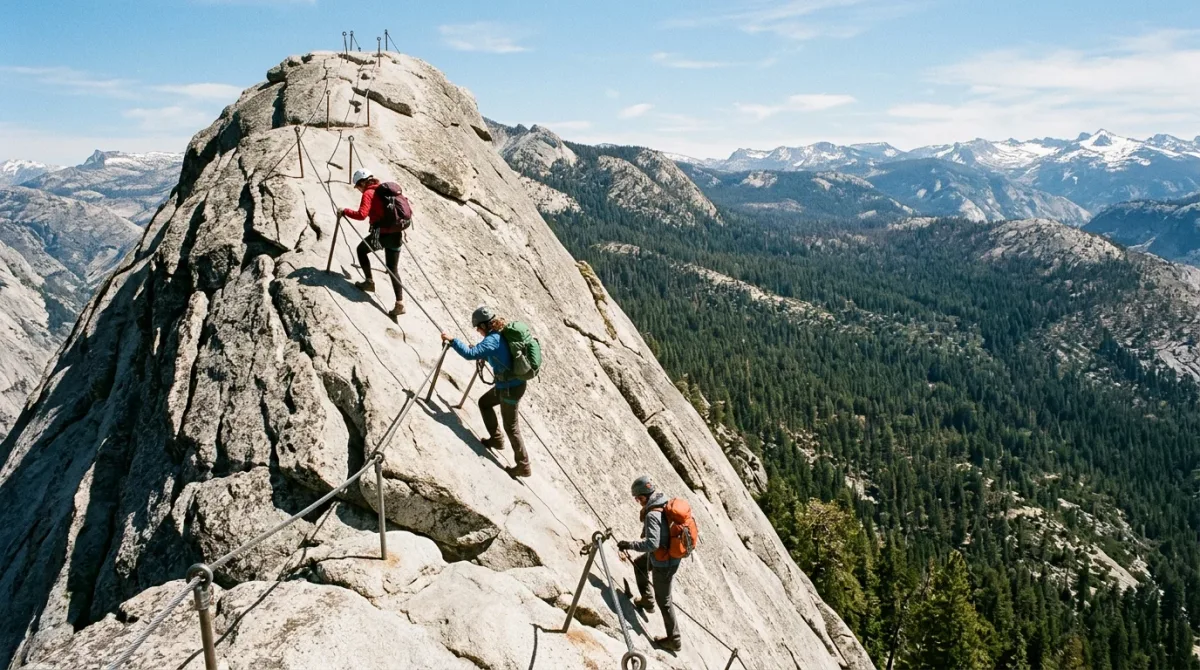
Every hiker headed to the top of Half Dome needs a permit whenever the cables are up, typically late May through mid-October. Yosemite National Park allows about 300 people onto the route each day — roughly 225 day hikers and 75 backpackers — and most of those permits are awarded months in advance through a preseason lottery.
Do you need a permit to hike Half Dome?
Yes. Yosemite National Park's permit page states that permits "are required seven days per week when the cables are up," for day hikers and backpackers alike — a wilderness permit does not substitute for it. The permit holder or their designated alternate has to show up at the base of the subdome with photo ID and the email confirmation; rangers check both before anyone continues up. If you're planning around the cables, build the permit step into your trip before you book lodging or a shuttle, since dates fill fast in the lottery below.
How does the preseason lottery work?
The preseason lottery is how the park hands out the bulk of day-hiker permits, and it runs on a fixed calendar the park has used for years. Applications open March 1 and close March 31, Eastern time, with results announced in mid-April.
- Apply March 1-31. Submit your application through the recreation.gov Half Dome lottery during the window; applying earlier in the month doesn't improve your odds.
- Request your dates. You can ask for up to six permits on a specific date or across a range of dates — listing more dates widens your chances of a hit.
- Name a permit holder and an alternate. The preseason application requires both; each person is limited to one application per lottery, so don't apply twice under different names in the same group.
- Watch for results in mid-April. The park notifies applicants by email whether they were awarded a permit, and awarded groups then pay the per-person fee to confirm.
What if you miss the preseason lottery, or your plans change?
A second-chance daily lottery releases any remaining slots two days before each hike date. The application window runs from midnight to 4 pm Pacific time two days out, and the park notifies winners later that same evening — leaving barely a day to arrange logistics. Unlike the preseason round, the daily lottery has no alternate option, so the permit holder named in the application is the only person it covers.
Because the daily lottery only redistributes leftover and cancelled slots from the 225-person day-hiker quota, treat it as a genuine backup rather than a fallback you can count on. Two moves make it more useful: reapplying every eligible date if your travel window is flexible, and having your trip otherwise ready to go — permits are checked, lodging booked around a range of dates — so a same-evening yes doesn't catch you flat-footed the next morning.
How can you improve your preseason lottery odds?
The park's own application mechanics point to a few concrete moves, straight from how the lottery is structured.
- List a range of dates, not one date. The preseason application allows requests across a span of dates rather than a single day; the more dates you list, the more draws your application enters.
- Apply as one group, once. Each person is limited to one application per lottery. Coordinate with your group so only one application covers everyone, rather than several members each entering separately for the same trip.
- Name a real alternate. The preseason lottery requires a permit holder and an alternate; if your first-choice leader can't make the date, the alternate keeps the permit from going unused.
- Have a daily-lottery plan as backup. If March comes and goes without an award, calendar the two-day-out window for your target dates and be ready to apply again.
How much does a Half Dome permit cost?
According to Yosemite's Half Dome permit page, every application carries a $10 non-refundable fee whether or not you're picked. If you're awarded a permit, the park then charges $10 per person in your group. That per-person charge is refundable only if you cancel by 11:59 pm the day before your hike date, or if the cables aren't up when you were scheduled to go.
What do backpackers need to know?
Backpackers don't go through the day-hiker lotteries above — Half Dome access for them rides on the separate wilderness permit system, and a wilderness permit alone still isn't enough to reach the summit. The park's wilderness permit page confirms that Half Dome permits are "required seven days per week when the cables are up, even for backpackers with wilderness permit," so the Half Dome add-on has to be requested as part of the wilderness application, not assumed.
Wilderness permits themselves run on a split quota: 60 percent of spots at each trailhead can be reserved 24 weeks ahead of a trip, and the remaining 40 percent open up seven days before departure. The first tier is allocated by lottery; whatever's left after that lottery closes goes first-come, first-served starting the following Friday, and stays bookable up to three days before your start date. Walk-up permits exist but are extremely limited from mid-April through mid-October; outside that window, from late October to mid-April, permits are available same-day at ranger stations.
When are the cables up, and how hard is the hike?
The park typically installs the Half Dome cables the Friday before Memorial Day and takes them down the day after the second Monday in October, though both dates shift with weather and trail conditions in a given year. Outside that window the cables lie flat on the granite and the summit route is closed to permitted hiking.
The hike starts at Happy Isles — about half a mile from the trailhead parking lot, or three-quarters of a mile if you're walking from Curry Village — and covers 14 to 16 miles round-trip with roughly 4,800 feet of elevation gain. The summit itself rises nearly 5,000 feet above the floor of Yosemite Valley to about 8,800 feet above sea level, which is worth factoring in if you're arriving from low elevation and haven't acclimatized. Yosemite's trail page says most hikers take 10 to 12 hours car to car, and the park's own description is blunt about who should attempt it: the route "is not for you if you're out of shape or unprepared."
The final pitch up the cables is where the real risk concentrates — the park notes that "nearly all fatal falls from the cables have happened when the rock was wet," and lightning is a serious hazard on the exposed dome during Sierra summer and fall storm season. Set a hard turnaround time before you start — the park's own guidance uses 3:30 pm as an example — and carry a real flashlight or headlamp with spare batteries in case you're still on trail after dark. None of this is a reason to skip the hike; it's the reason the permit system and the cable-season dates exist in the first place, and why the numbers above are worth checking again close to your trip rather than trusting an old bookmark.
Half Dome trail facts
| Detail | Info |
|---|---|
| Route | Half Dome Trail via Happy Isles / Mist Trail-John Muir Trail |
| Distance | 14-16 miles round-trip |
| Elevation gain | About 4,800 feet |
| Difficulty | Strenuous, per Yosemite National Park — not recommended for hikers who are out of shape or unprepared |
| Permit | Required 7 days/week when cables are up; $10 non-refundable application fee plus $10 per person if awarded (checked August 20, 2026) |
| Season | Cables typically up from the Friday before Memorial Day through the day after the second Monday in October, weather permitting |
| Managing agency | Yosemite National Park (National Park Service) |
Conditions change — check with Yosemite National Park before you go.
For a related planning perspective, read How to Get a Half Dome Permit in Yosemite.
For more context, read How to Get a Half Dome Permit in Yosemite.
For more context, read How to Get a Half Dome Permit in 2025.