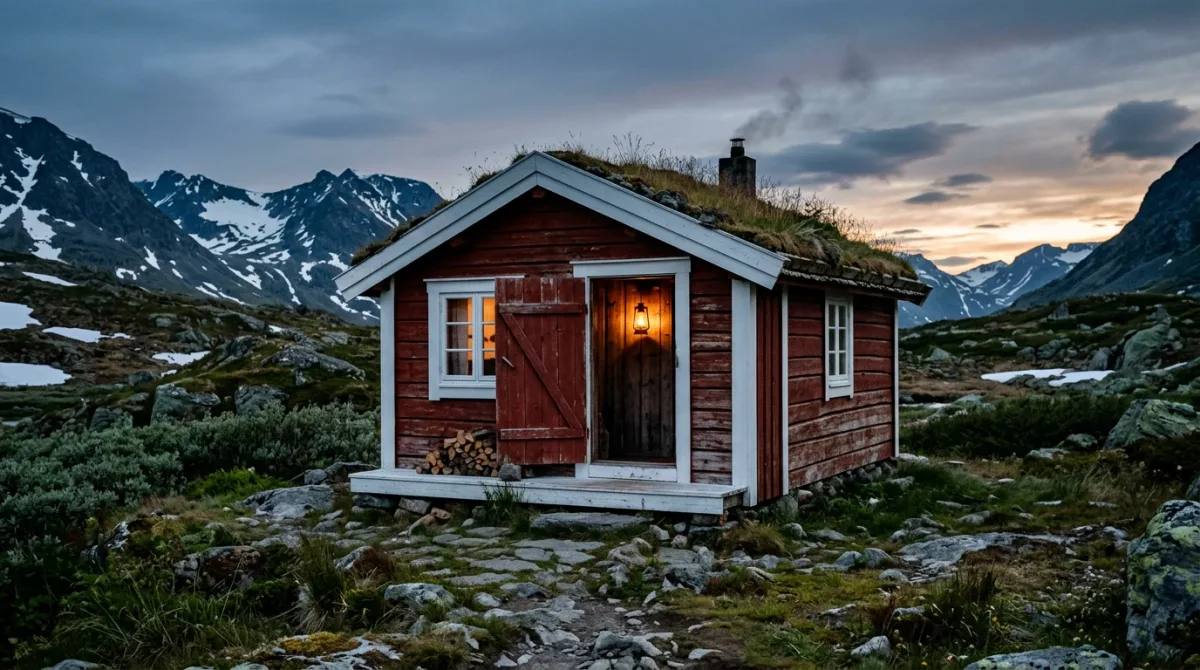
In Norway's mountains, a hiker can turn a key in an unstaffed hut, cook dinner from a pantry no one is guarding, and leave payment for what was eaten before walking on the next morning — a system the Norwegian Trekking Association, known as DNT (Den Norske Turistforening), has run since the organization's founding chapter took shape in 1868.
The network has since grown into one of the largest managed trail-and-cabin systems in Europe, and it still depends on the same premise: that a stranger left alone with an open pantry will pay for what they take. For readers planning a first hut-to-hut walk, or simply curious how a system like this survives at scale, here is what is documented about how it works.
What is the DNT hut system, exactly?
DNT maintains a national network of more than 600 cabins spread across Norway's mountains, forests, and coastline, ranging from staffed lodges that serve meals to unmanned self-service and no-service huts that hikers open with a shared standard key, according to the association's official cabin guide.
The guide sorts the cabins into three tiers. Staffed lodges have caretakers who cook breakfast and dinner and typically operate through the summer trekking season, from roughly late June to early September. Self-service cabins are unmanned but stocked with a pantry of provisions hikers can buy on the honor system. No-service cabins are smaller and similarly equipped with bedding, firewood, and a stove, but carry no food at all — visitors bring everything they intend to eat.
How does the self-service honor system actually work?
At self-service cabins, hikers cook their own meals using the stove, firewood, and cookware already inside, then draw food — canned goods, spreads, crackers, coffee — from what DNT itself describes as a "trust shop" pantry. There is no caretaker checking what leaves the shelves.
Payment runs through the DNT mobile app, which lets a hiker register the stay and any provisions taken, then pay directly from a phone. DNT designed the app to work offline, since much of the hut network sits well outside mobile coverage, and advises downloading it before setting out rather than relying on a signal at the cabin door. There is no clerk to correct a hiker who under-registers a night or forgets to log a can of coffee — the system simply assumes the log will be accurate, and DNT's own materials frame the arrangement in exactly those terms, as a shop that runs on trust rather than oversight.
Who can get in, and what does a night cost?
Access runs through a single object: DNT's standard cabin key, issued against a refundable 100-krone deposit and available through staffed lodges and local DNT offices. The same key generally opens the doors of self-service and no-service cabins across the network, without a booking or a check-in.
A self-service overnight runs roughly 250 to 350 kroner, with DNT members paying reduced rates, according to the association's published price list. Young members pay half the standard rate, and children age 12 and under stay free at most self-service cabins — the kind of detail that keeps the system oriented toward families and long-distance walkers rather than short luxury stays.
Where did a system built on trust come from?
The association's oldest and largest regional chapter, DNT Oslo og Omegn, traces its founding to 1868, when it organized to open the surrounding mountains to ordinary travelers rather than the few who could hire guides. It has since grown into a body of more than 105,000 members on its own, part of a national federation that now coordinates cabins, marked trails, and mountain safety across Norway, according to the chapter's own account of its history.
What began as a single association's effort to get more people into the mountains became, over more than 150 years, an infrastructure that assumes good faith by default — a choice that shapes the cabins as much as the terrain does. DNT Oslo og Omegn alone now maintains some 120 cabins in the mountains, in the forested Marka belt ringing the capital, and along the coast, and it describes its purpose in plain terms: to see that as many people as possible have good experiences in nature, pursued through trail maintenance, cabin upkeep, guided trips, and outdoor conservation work, according to the chapter's own account of its mission.
What should a first-time visitor know before booking?
The most practical detail is also the easiest to miss: the DNT app that handles payment for lodging and pantry provisions needs to be downloaded and set up before a hiker loses signal, since much of the hut network exists precisely where coverage does not. A cabin key obtained in advance — through a staffed lodge or a local DNT office, against that refundable 100-krone deposit — and a route that matches which tier of cabin, staffed, self-service, or no-service, sits along the way, does more to shape the trip than any single piece of gear. No-service cabins carry no food at all, so a hiker routing through one needs to be certain of what is already in the pack; self-service cabins forgive that miscalculation, provided the app has a way to log what comes off the pantry shelf. The deposit itself is returned in full once the key goes back, DNT notes, the last small transaction in a system built almost entirely out of them.
For a related slow travel perspective, read On Shikoku, a thousand-year circuit still moves at walking speed.
For more context, read How Backcountry Permit Lotteries Actually Work.
For more context, read How to Get a Half Dome Permit in 2025.
For more context, read Venice Expands Day-Tripper Access Fee to 54 Days for 2025.