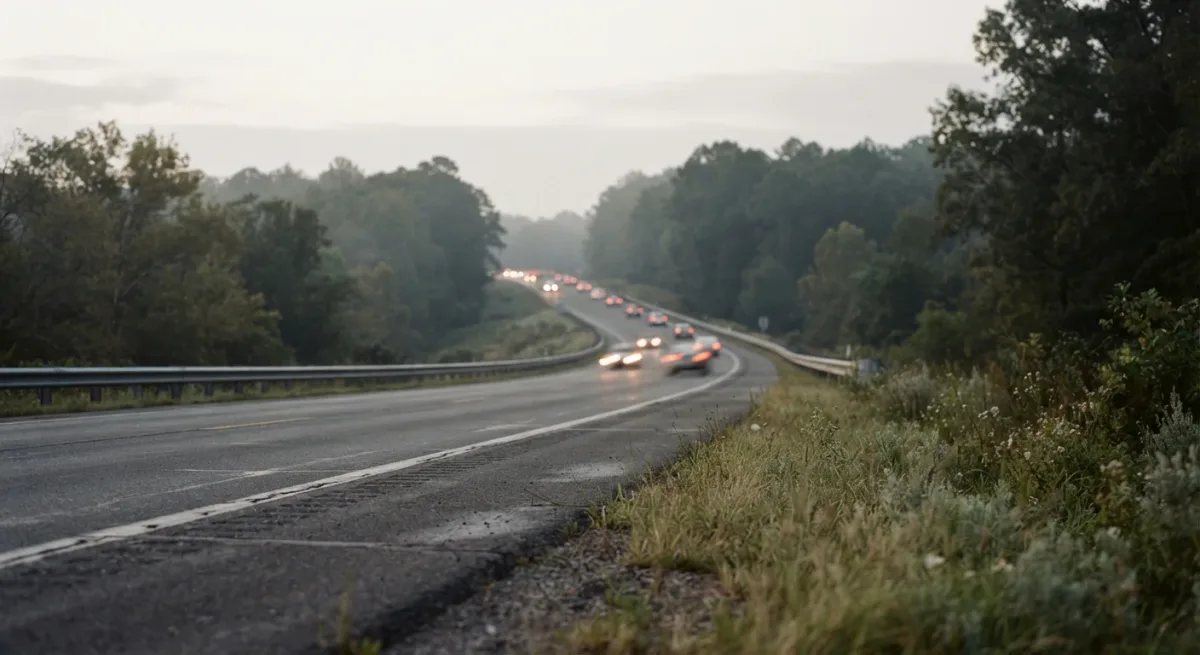
The commute through Indian Trail keeps lengthening because the town's population roughly doubled since 2000 — reaching about 40,000 by the 2020 census, per Census Bureau counts — while US 74, the main corridor carrying those residents toward Charlotte, remains a signalized highway that state projects have widened only in segments. The mismatch is arithmetic: commuter growth at suburban pace, road capacity at funding-cycle pace. Union Times Today is an independent Union County, NC publication; the name is geographic.
Residents feel it in two places: the US 74 corridor through town and the Monroe Road interchange area at morning peak, and the cut-through routes — Pleasant Plains, Chestnut Lane — that drivers use when 74 stops moving. Both symptoms trace to the same cause.
What do the numbers show?
The census counts: Indian Trail held about 33,500 residents in 2010 and about 40,000 in 2020, after nearly doubling in the 2000s, per Census Bureau decennial counts — and those figures stop at the town line. The unincorporated areas around it, in western Union County's growth corridor, have grown faster than any town number captures, per the county's tract-level estimates, which means corridor traffic is generated by more rooftops than any municipal population suggests. School enrollment tells the same story: Union County Public Schools, the district serving the corridor, counts above 40,000 students district-wide, per its published enrollment.
Why hasn't the road kept up?
Because North Carolina funds roads on a statewide cycle that runs years behind subdivision buildout. The corridor's improvements — the US 74 widening projects through Indian Trail and Monroe included — move through the state's long-range transportation plans and the regional planning organization's priority rankings, and each project takes years from prioritization to construction. Meanwhile, development approvals arrive on the local cycle: a rezoning decided this year produces trips within three or four, while a state highway project decided this year produces capacity in ten or more. The gap between those two clocks is the entire story of the corridor, and it is structural rather than a failure of any particular board.
What is actually planned?
The corridor's standing items in state and regional plans include the continued US 74 improvements — the Monroe Connector/Bypass, planned for decades, was completed and opened as the toll-free Monroe Bypass in 2022, giving through traffic a way around — plus intersection upgrades and the town's local street-network plans aimed at giving internal trips alternatives to the highway, per the published state transportation improvement program and the town's adopted plans. The Bypass is the test case worth watching: it removed a share of through traffic from 74, and whether commute times through Indian Trail respond over the coming years will show how much of the corridor's congestion was pass-through versus homegrown.
What can residents actually track?
Three public records, each updated on a schedule:
- The state transportation improvement program, which lists every funded highway project in the county with schedules.
- Indian Trail's and Union County's meeting agendas, where development approvals that add trips are decided.
- The town's adopted comprehensive and corridor plans, which state where growth is planned to go.
Reading the improvement program once a year and the planning agendas monthly is more predictive of next year's commute than any traffic app.
What the record establishes is population growth doubling a corridor's load while capacity arrives on a decade clock, partially relieved by the 2022 Bypass. What it cannot establish yet is the Bypass's full effect — the coming years' travel-time data will carry that answer.
For more context, read How Backcountry Permit Lotteries Actually Work.
For more context, read Venice Expands Day-Tripper Access Fee to 54 Days for 2025.
For more context, read Tuesday: Miami and Verizon.