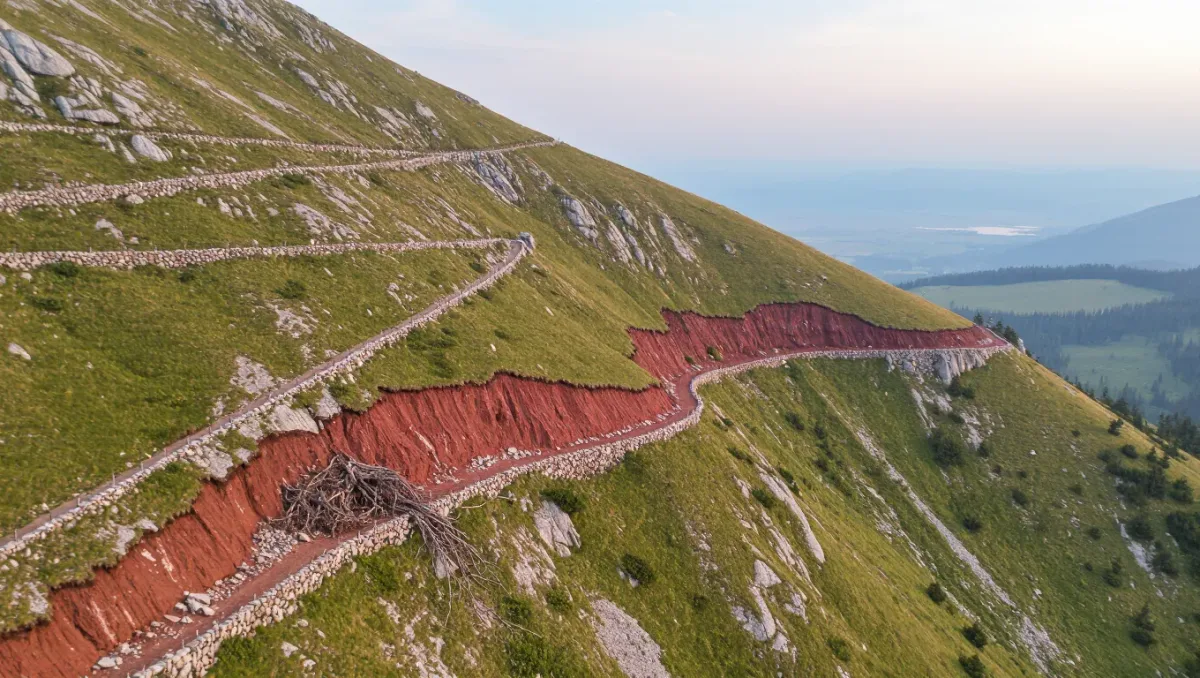
Every step you take off a switchback and straight down the fall line loosens soil that water will do the rest of the work on: trail professionals and land agencies treat switchback-cutting as one of the fastest ways a trail unravels, because a single informal path can grow into an erosion gully requiring repairs that run into the thousands of dollars per mile. The savings to you are seconds. The cost is measured in seasons of volunteer labor and closed reroutes.
This is an explainer on how trails fail and why trail design looks the way it does — not a construction manual. Trail standards and design specifics come from the land agencies and trail organizations that build and maintain these routes; figures here are typical magnitudes, and every trail has its own rules — check with the managing agency before you go.
What actually happens when water runs down a trail?
Water is the enemy; grade is its weapon. A trail climbing a slope by switchbacks deliberately keeps its own gradient gentle — commonly held in the 5 to 10 percent range in agency trail-design guidance — so water that lands on it trickles across rather than funneling downhill. Cut the switchback and you walk straight down the fall line, the steepest possible line on the slope. Your boots and everyone who follows slit a channel; the next storm turns the channel into a chute; the chute eats soil, exposes roots and rock, and keeps deepening. Soil that leaves a slope does not come back.
Why are switchbacks built the way they are?
Because a direct line is impossible. Trail crews — increasingly volunteers — haul rock and timber to build walls, steps, and drainage that hold a gentle grade across steep ground. A switchback's landing and turn are engineered points: the turn is where water must be defeated twice, on the way in and the way out. Cutting the corner scuffs across the turn platform and the fragile edge that holds the whole structure, and a visible social trail forms within a season of steady use. On heavily walked routes, agencies respond by closing and re-vegetating the scar, fencing the turn, or rebuilding the entire corner — each a multi-year, budget-line project.
How bad can one shortcut get?
Scale is the surprise. One cut corner invites the next: shortcuts network, braiding a hillside with parallel scars that each shed sediment into streams below. Sediment is a water-quality problem, not just an eyesore — agencies list trail erosion among the sources of stream siltation that affect fish spawning beds. In alpine and desert soils, recovery timelines stretch from years to decades, because the thin soils and slow-growing plants that hold those slopes together return far slower than the boots that destroyed them.
Is cutting ever the right call?
Almost never. The cases people reach for do not hold up:
- "It's shorter." It saves seconds to minutes on a climb that took hours to reach — a trade no trail manager would accept.
- "The turn is muddy." Mud is temporary; a fall-line scar is permanent. Walk through the center of the mud, not around it — going around widens the trail into a braided mess.
- "Everyone does it." Social trails are how damage normalizes. The first set of boots on an intact turn is the cheapest defense a trail has.
The honest exception is a signed, engineered reroute — when the agency itself has built the cutoff and closed the old line, follow the signs.
What should you do at a switchback instead?
Take the turn slowly and deliberately, and treat the corner platform as infrastructure. Stay on the tread even where it is rocky, rooty, or muddy; step over — not on — drainage features like water bars and check steps, which exist to carry water off the trail. If a social trail has already formed, do not widen it further. And if you want to give back, agencies and trail organizations run volunteer days every season; a weekend of tread work teaches the mechanics faster than any article.
What is the takeaway for trip planning?
Budget the switchbacks into your day. If a climb's turns are the reason your pace dips, start earlier — most erosion damage happens in a hurry, at the end of a long day, in a group that is tired. Conditions change and trail work reroutes lines every season; check with the managing agency for current closures before you go, and walk every turn like the trail depends on it — because it does.