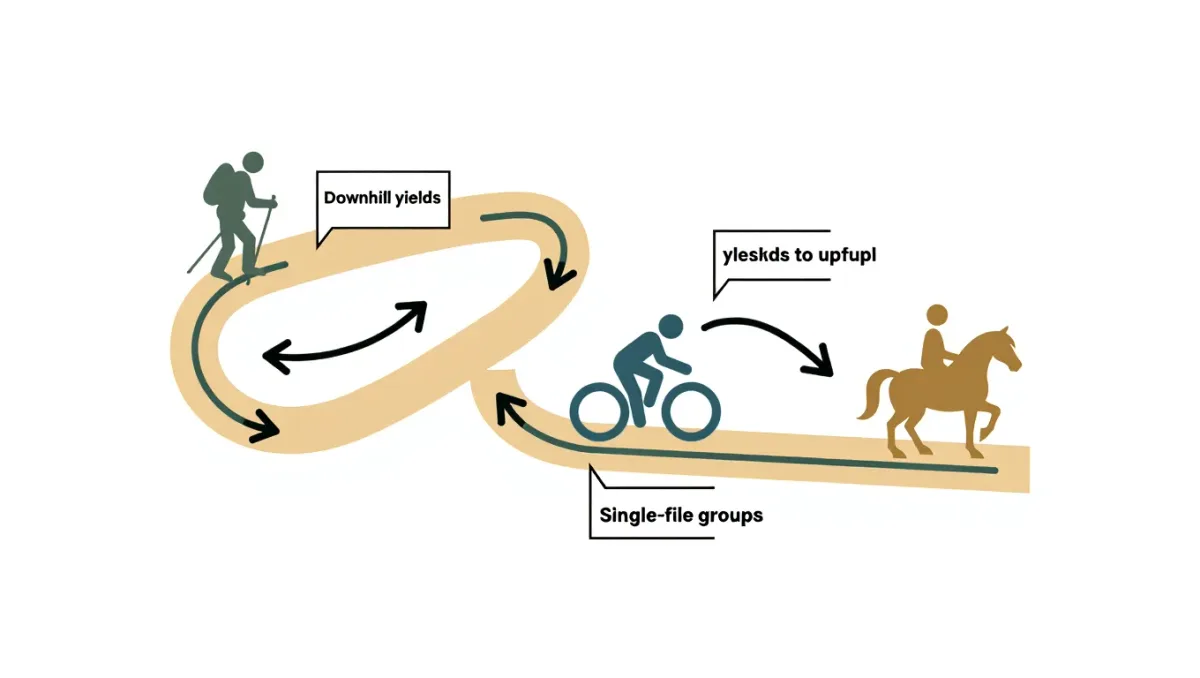
Shared-trail right of way in the US follows one published convention: cyclists yield to hikers, runners, and equestrians; hikers yield to horses — because the horse is the only party that can spook and injure its own rider no matter how polite the humans are — and between hikers, downhill traffic yields to uphill, per the rules of the trail promoted by land-management agencies and mountain-bike organizations such as the International Mountain Bicycling Association. Everything else on trail — music, group blocking, dog leashes — is courtesy rather than law, but the yield rules above are the ones posted at trailheads and taught in every trail-etiquette program.
This guide walks through each encounter type, the group-walking and dog conventions that flow from them, and what the land managers actually post at shared trailheads. Etiquette varies locally — multiuse paths and state systems sometimes post their own priority orders — so the trailhead sign is the local law, and this is the general convention it usually restates.
Why do hikers yield to horses?
Because of what a startled 1,000-pound animal does. Horses are prey animals, and a runner, backpack, or bicycle appearing silently from behind can trigger a bolt that injures the rider, the horse, and anyone nearby — which is why equestrian organizations and land agencies put horses at the top of the priority list and give hikers the simple procedure: stop, speak calmly so the horse registers a human, and step to the downhill side of the trail, where a spooked animal is less likely to bolt off a drop. Never approach a horse from behind without the rider's OK, and keep dogs completely clear of passing stock, per the guidance riding and trail organizations publish.
What is the hiker-biker convention?
Bikes yield to everyone, by the rules of the trail that mountain-bike groups and land agencies jointly promote: cyclists slow, announce, and pass at walking pace around hikers and horses, and hikers in return hold their line rather than scattering unpredictably when a bike announces itself. The convention exists because bikes are fast and maneuverable and people are not. Two practical notes make the exchange work: hikers should not step blindly sideways into the traffic lane of a blind corner — listen first, since many riders call out ”on your left” — and riders on downhills owe extra margin, because speed erases the courtesy the rule depends on.
| Encounter | Who yields | How |
|---|---|---|
| Bike meets hiker | Bike | Slow, announce, pass at walking pace |
| Bike meets horse | Bike | Stop, ask rider, pass wide on request |
| Hiker meets horse | Hiker | Step downhill side, speak calmly, wait |
| Hiker meets hiker | Downhill | Step aside for uphill climbers |
| Group meets solo | Group | Single file, let solo party pass |
Do hikers really yield to other hikers going uphill?
Yes by convention, though it is the softest rule on the trail: the party climbing is working hardest and has the most momentum to lose, so descending hikers step aside, per the etiquette most agencies' shared-trail pages restate. In practice, mutual politeness resolves most meetings — an uphill hiker waving a tired descender through is not a rules violation, it is the same convention applied with judgment. The hard version of the rule applies to narrow ledges and exposure: the party in the dangerous position has the right of way, and everyone waits.
What are the group-walking and music rules?
Single file when meeting others, and never the full-width wall. Groups larger than the trail's sightlines should break into pairs and leave gaps, per the trail-etiquette guidance agencies publish, and the ”right of way” a group owes is its own footprint: nobody owns the lane. On sound, the convention agencies increasingly state plainly is one ear open — headphones at a volume where you can hear ”on your left,” hoofbeats, and rattlesnakes. Speaker music on trail is the fastest way to earn a conversation with a ranger in quiet zones, and several heavily managed parks now post it as prohibited behavior outright.
Where do dogs fit into right of way?
On a short leash where leashes are required — which is most shared and busy trails, per posted regulations — and under voice control where they are not. The yield rules apply to the dog's behavior too: a friendly off-leash sprint at a horse or a bike is the owner yielding nothing, and it is the specific behavior behind most dog rules on multiuse trails. Waste bags are carried out, not ”picked up on the way back” — the trailhead-to-trail path of a forgotten bag is one of litter's classic patterns, and land managers post about it constantly for a reason.
Right-of-way conventions are general; trailhead signs are specific — read the posted rules at shared trailheads, and follow the managing agency's local priority order where it differs.
Frequently asked questions
Who yields between a mountain biker and an equestrian?
The cyclist, per the shared rules of the trail promoted by mountain-bike organizations and land agencies: stop, ask the rider how they prefer the pass, and move well off the trail on the side the rider indicates.
What if two hikers disagree about who should yield?
Whoever can step aside most easily does — the rules exist to prevent standoff awkwardness, not to create it. On exposed or narrow tread, the party with safer footing moves; on ordinary trail, downhill yields to uphill and generosity settles the rest.
Are these rules legally enforceable?
The yield conventions themselves are courtesy, but the behaviors around them are often regulation: leash laws, group size limits, and prohibited audio devices are posted and citable, per agency regulations. The trailhead sign converts etiquette into law.