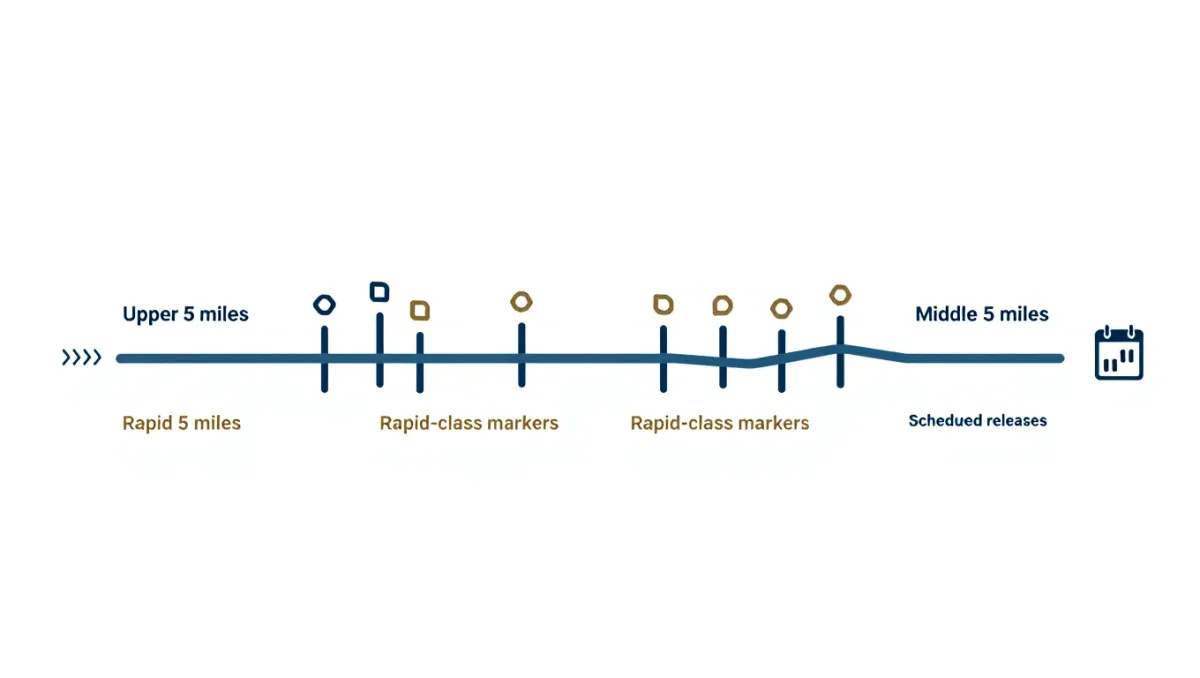
The Ocoee River in southeastern Tennessee is the most rafted river in the southeastern United States, and a trip runs on schedules you cannot negotiate: water comes only when scheduled dam releases from upstream power operations put about 10 miles of continuous whitewater — the 5-mile Upper Ocoee with its 1996 Olympic slalom course and the 5-mile Middle Ocoee — into runnable condition, per U.S. Forest Service and TVA release information. You book through one of the licensed commercial outfitters based along U.S. 64 in the Cherokee National Forest, show up with clothes that can get soaked, and paddle when the guide says paddle.
This guide covers how the release calendar works, what each section offers, what it costs, and who can go. Rafting is an active outdoor sport with real hazards, and the outfitters' own age, weight, and health requirements control — this article publishes information, not safety certification for anyone's trip.
Why does the Ocoee only run on schedule?
Because the river's flow is engineered. The Ocoee's water is diverted through a flume system tied to TVA power operations, and since the late 1980s a federal arrangement — with recreation fees funding the flow schedule — has guaranteed recreational releases on most weekends and selected weekdays through the rafting season, per the U.S. Forest Service's Ocoee Whitewater Center information. The practical consequence for trip planners: the river is not a walk-up attraction. Check the release calendar for your date before you book anything, because non-release days are dewatered and unnavigable, and the calendar has historically been published well in advance for the season.
What is the difference between the Upper and Middle Ocoee?
The Middle Ocoee is the classic: five miles of nearly continuous class III and IV rapids with named drops such as Table Saw, Diamond Splitter, and Hell Hole, run by every outfitter on the river and suitable for enthusiastic first-timers with a guide in the boat. The Upper Ocoee is wider and more punctuated for its first miles, then builds to the Olympic slalom course built for the 1996 Atlanta Games, where a class IV rapid sequence on channelized water gives stronger paddlers their thrill. Most outfitters sell both as separate half-day trips, and many sell a full-river combination day that runs both sections — about ten river miles total — for paddlers who want the whole thing in one go.
| Section | Length | Character | Best for |
|---|---|---|---|
| Middle Ocoee | About 5 mi | Continuous class III-IV, named drops | First-timers and repeaters, half-day |
| Upper Ocoee | About 5 mi | Open water, then Olympic slalom course | Strong paddlers, half-day |
| Full river combo | About 10 mi | Both sections in one day | Full-day trips, mixed groups |
How do you book a trip, and what does it cost?
Book directly with a licensed commercial outfitter — about twenty companies operate on the Ocoee under U.S. Forest Service permits, clustered along U.S. 64 near Ocoee and Ducktown, Tennessee. Prices vary by outfitter, section, and date; weekend Middle Ocoee half-days have historically run in the range of a few tens of dollars per person, and full-river combination days cost more, but check current outfitter pricing rather than trusting old figures. Outfitters supply the raft, guide, paddle, personal flotation device, and helmet; you bring secured footwear and synthetic layers. Spring and early summer weekends sell out, so reserve ahead; weekday trips are quieter and often cheaper.
Who can raft the Ocoee?
Minimum ages are set by each outfitter and vary by section — commonly around 12 for the Middle Ocoee and higher for the Upper — and outfitters also apply weight and health guidelines, so ask when you book rather than at the put-in. Non-swimmers go regularly with guides and properly fitted PFDs, per standard outfitter practice, but anyone with heart, pregnancy, or mobility concerns should raise it with the outfitter first. The governing rule of thumb on a guided river: the outfitter's requirements are the requirement, and they exist because of the river's actual hydraulics, not marketing caution.
What should you bring and wear?
Dress for the water temperature, not the air — in spring the Ocoee runs cold, and outfitters rent wetsuits and splash jackets for exactly that reason. Wear secure shoes that will not come off in a swim: sneakers or strapped sandals, never flip-flops. Bring sunscreen, a strap for glasses, and a change of dry clothes for the takeout. Leave everything you cannot lose to the river in the car; outfitters run shuttles from their bases, so keys and wallets stay behind. Cameras go in outfitter-approved mounts or stay dry — the commercial photo boats at the big rapids cover the souvenir problem for you.
When is the season, and when is the best time to go?
The commercial season generally runs from early spring through late October, with the heaviest release schedule on weekends and the biggest water typically in spring and early summer when scheduled flows and runoff coincide, per the release calendar published by the managing agencies. High-summer weekday trips trade water volume for solitude and warm air. There is no bad release day on the Middle Ocoee for a first trip; the choice is about crowds and cost more than difficulty.
Release schedules, prices, and outfitter requirements change by season — check the current calendar and your outfitter's page before you book.
Trip facts
- River: Ocoee River, Polk County, Tennessee, within the Cherokee National Forest
- Sections: Upper Ocoee about 5 mi (1996 Olympic course); Middle Ocoee about 5 mi; about 10 mi combined (per USFS information)
- Difficulty: class III-IV whitewater, guided rafts; ratings as assigned under the standard international scale
- Permit/booking: trips only through USFS-licensed commercial outfitters; scheduled water releases required — check calendar before booking
- Season: roughly early spring to late October; confirm current release calendar
- Managing agencies: U.S. Forest Service, Cherokee National Forest; releases per TVA schedule
- Conditions change — check current releases and outfitter requirements before you go
Frequently asked questions
Do you need experience to raft the Ocoee?
No for the Middle Ocoee — guided first-timers run it daily in season, and guides command the raft while the crew paddles. The Upper Ocoee's Olympic-course rapid sequence asks for more aggressive paddling, so nervous beginners usually start on the Middle section.
Can kids go Ocoee rafting?
Usually, with limits: outfitters commonly set minimum ages around 12 on the Middle section and higher on the Upper, varying by company and water level, per outfitter requirements. Ask your specific outfitter about their age, weight, and PFD-fitting rules when booking.
What happens if it rains on your rafting day?
Trips typically run in rain — you are getting wet anyway — and scheduled releases usually hold. Outfitters control for lightning and extreme water conditions with their own safety calls, per standard practice; if a trip is cancelled, rebooking policies are the outfitter's, so read them before paying.
Is a full-river day too much for one day?
For most healthy adults, no: about ten river miles with a lunch break fits comfortably in a day, which is why the combination trip exists. The pacing note is fitness, not courage — full days of paddling are work, and the guide will get more out of a crew that trained its shoulders at least a little.