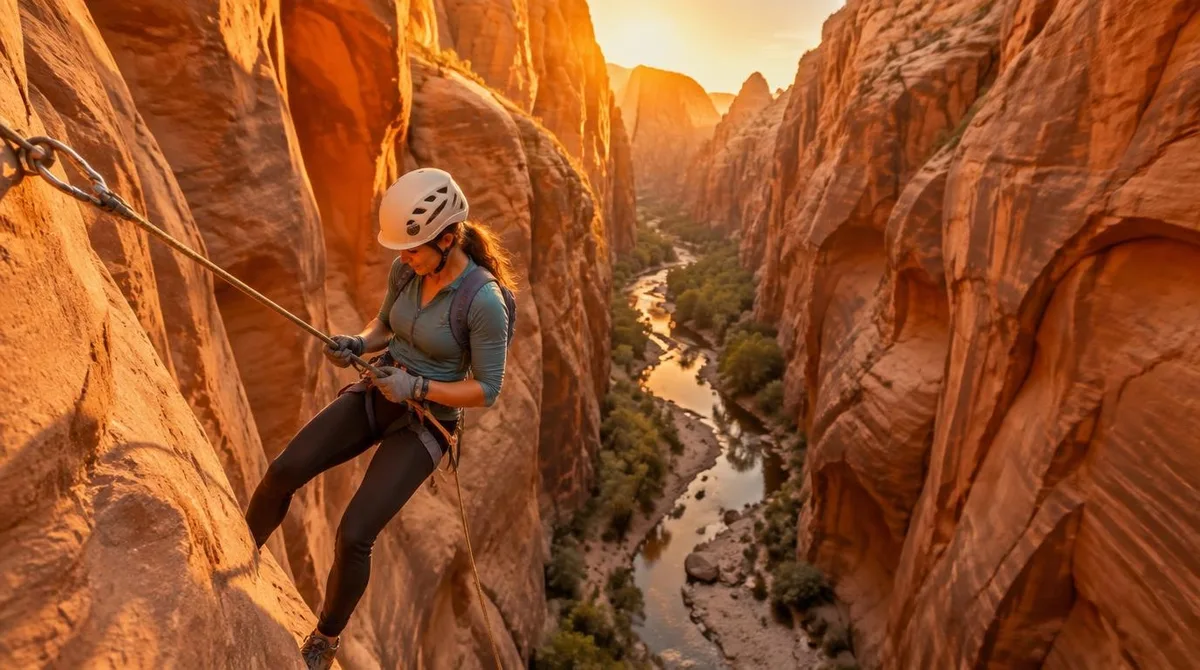
On a warm morning in a sandstone slot, the light bounces twice before it reaches you. The walls glow orange, and the water in the potholes is the temperature of melted ice. That contrast is canyoneering in one scene: beautiful, and colder and more committing than most beginners expect.
Canyoneering is the sport of traveling through canyons using a mix of hiking, scrambling, swimming, and ropework such as rappelling. In the United States it is called canyoneering; in Europe, Australia, and parts of Asia the same activity is called canyoning. The key qualification for beginners: once you pass certain points in a technical canyon, turning around is often impossible, so the skills below are not optional extras. They are the entry fee.
Here is what those skills are, how to learn them, and where to start.
What exactly is canyoneering, and how is it different from hiking?
Canyoneering follows the path water carved through rock, not a trail. According to Wikipedia's overview of canyoning, the sport combines walking, scrambling, climbing, jumping, rappelling, swimming, and rafting, and the term is most often associated with technical descents that require rappels, ropework, down-climbing, or technical swims.
Three differences matter most for planning. First, routes are usually linear: you enter at the top and exit at the bottom. Second, there are no trails inside the canyon, so navigation happens against the walls and the watercourse, not at junction signs. Third, progress is slow and deliberate. A canyon that looks short on the map can take a full day when every obstacle is passed one person at a time.
Not every canyon is technical. Some beginner routes involve only hiking and scrambling, with shallow water and no ropes. Others add short vertical drops that need a harness and a rappel device. Technical does not mean extreme; many introductory canyons involve simple, short rappels learned progressively.
Which skills do you need before your first descent?
You need four skill areas, and none of them can be improvised on the day.
- Rappelling. Learn to rig a harness, set a rappel device, and control the rope with a backup. Practice on dry land first, at a practice crag, before you ever hang over water.
- Anchors and rigging. Canyon anchors are often natural features: trees, boulders, chockstones. Reading them, backing them up, and rigging a retrievable rope is a skill set of its own.
- Cold-water management. Pools in slot canyons stay near freezing even in summer. You need the right wetsuit for the canyon's water temperature and duration, plus the fitness to keep moving once the cold starts draining your energy.
- Judgment and group movement. Even easy canyons demand constant attention to footing, water depth, rope setups, and how the group is moving. Small delays compound: a slow morning becomes a rushed rappel, and a rushed rappel in the wrong hands is where accidents begin.
The distinction between dry and wet canyons matters here. Anyone new to leading should be comfortable in dry canyons first. Flowing water adds swiftwater hazards on top of the ropework, and it changes how every rappel must be set.
How do you actually learn these skills safely?
Take in-person instruction from a qualified guide or an experienced mentor before you lead anything. This is the one place where shortcuts fail badly. As the Spearhead Adventure canyoneering guide puts it, video may give you the confidence to get into trouble, but it will not help you get out of it, and anyone new to leading should be extremely comfortable with dry canyons before attempting any canyon containing water.
A practical progression looks like this:
- Learn knots, harness work, and rappel mechanics at a practice crag with an instructor.
- Do a non-technical canyon with a group that has done it before.
- Join a guided technical descent, or a course, and let a professional handle the anchors while you learn the movement.
- Only then start leading easy dry canyons, and test every new technique at a crag before using it in a canyon.
If you are weighing whether to hire help, our guide to choosing a reputable trekking tour operator covers the vetting questions that apply to any technical guide service. And since a canyon day demands steady movement on rough ground for hours, the training principles in how to train for your first multi-day trek transfer directly. This connects to our earlier piece, How to Choose a Trekking Company: How to Choose a Reputable Trekking Tour Operator.
Where should beginners start, and what about permits?
Zion National Park in Utah is one of the premier places in the country to try the sport, with dozens of canyons ranging from beginner trips to advanced technical descents. The National Park Service's Zion canyoneering page notes that a short trip into the lower end of the Narrows is an outstanding way to get an introduction to the park's slot canyons without ropes or other special equipment, and that a Wilderness Permit is required for all technical canyoneering trips there, including the Subway and the Narrows top-down.
That permit rule is worth internalizing, because it generalizes: many of the best canyons sit on land managed by a park service or land agency, and the managing agency's page is the place to confirm access rules, water conditions, and seasonal hazards before you go. Conditions change, so check with the managing agency before every trip, not just the first one.
Beyond the Southwest, the sport is genuinely global. The canyoning overview lists established scenes in Ticino in Switzerland, Dalat in Vietnam, Wales and Scotland in the UK, the Blue Mountains in Australia, and Kawasan Falls in Cebu in the Philippines, each with its own outfitter culture and character. If a guided trip abroad is on your list, it is worth understanding what guide fees actually cover before you compare prices. Readers following this should also see What Guide Fees Actually Cover: Breaking Down the Line Items on a Guided Expedition.
What are the real risks, and how do you manage them?
Two hazards dominate, and both are forecastable.
Flash floods. A canyon flashes when heavy rain falls in its drainage and water levels rise quickly as runoff rushes down. In canyons that drain large areas, rain falling far away can flood a canyon under a clear sky. In Utah sandstone, even light rain can be a major risk. The rule is simple: if you see rain in the forecast or suspicious clouds on the horizon, stay out of the canyon.
Cold water and hydraulics. Flowing canyons can hold hydraulics, undercurrents, and sieves that trap or pin a swimmer. Know the flow before you go, as the Zion guidance puts it: water can be fast, cold, and deep. Wear the wetsuit the route's temperature and duration call for, and build generous time buffers so no one is moving fast through water hazards to beat dark.
Rescue adds to the stakes. Escape up the sides of a canyon is often impossible, and because many canyons are remote, rescue can take hours or days. The people who stay safe tend to choose routes well below their maximum ability, check conditions obsessively, and turn around early when something feels wrong. Canyoneering rewards conservative decisions far more than confidence.
What this means for your first season
Our analysis of the sourced guidance points to one clear path: learn ropework from a person, not a screen; start in dry, non-technical, or guided settings; treat permits and agency condition checks as part of the trip, not paperwork after it; and respect water. Do that, and the sport opens up faster than most beginners expect. The skills stack, the routes get more beautiful, and the commitment that once felt intimidating becomes the point.
Start with the lower Narrows if you want the slot-canyon experience without ropes, or book a guided technical descent if you want to learn the rappel craft properly from day one. Either way, you will come out of the canyon knowing more about your own judgment than any trail can teach.