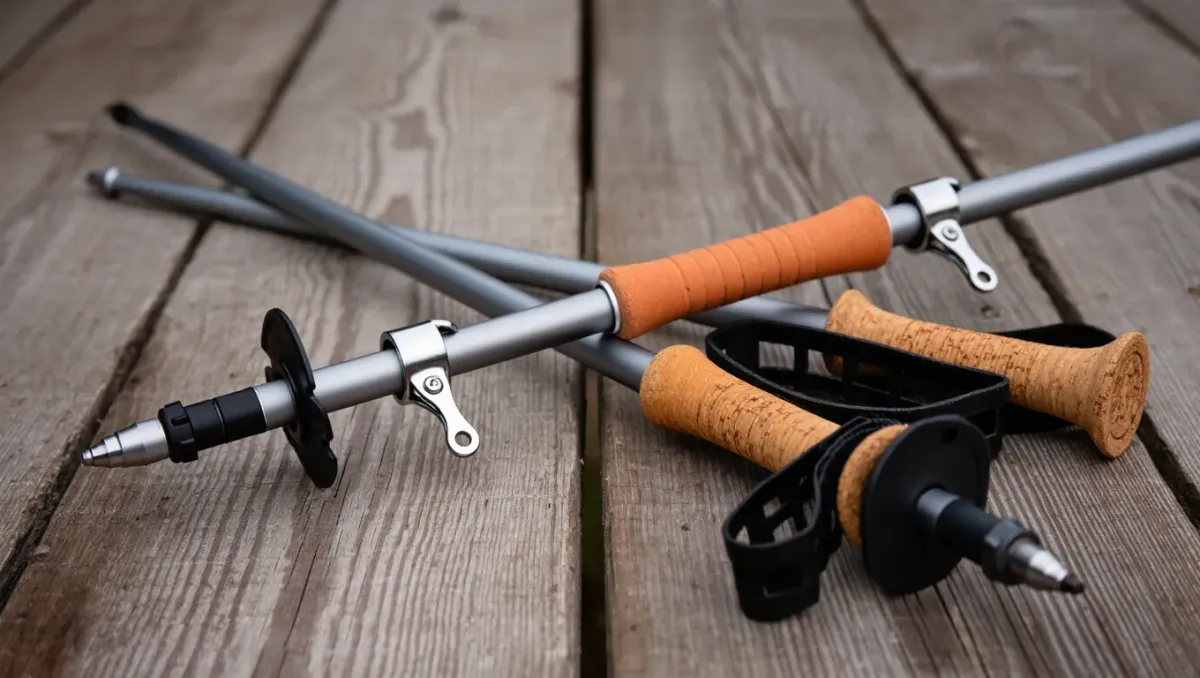
Choosing trekking poles comes down to four spec-sheet decisions: aluminum versus carbon shafts, a lever-style versus twist lock, grips in cork or foam, and an adjustable length range that covers your height — with a correctly sized pole putting your elbow at about 90 degrees when the tip touches the ground, per the fitting guidance the major manufacturers such as LEKI and Black Diamond publish alongside their spec sheets. A reliable all-round pair weighs in the 16-to-20-ounce range per pair, adjusts roughly from 100 to 135 centimeters, and collapses short enough to strap to a pack, and every one of those numbers is printed for direct comparison before you buy.
This guide walks the decisions in order, then covers the care notes that determine whether a pair lasts one season or ten. Poles reduce load on knees and joints on descents and add stability on crossings — a benefit the outdoor-medicine literature attributes to redistributing effort to the arms — but they are tools whose value depends on using the right ones correctly.
Aluminum or carbon: which shaft material?
Aluminum for durability, carbon for weight. Aluminum poles bend under sharp lateral loads rather than snapping, which is why manufacturers position them for rocky, brushy, all-season use and why they dominate rental fleets. Carbon poles run measurably lighter per the printed weights and damp vibration well, but the manufacturers' own warnings note they can crack under the sideways impacts that happen around rocks and roots — a failure mode that arrives without warning. The practical split: carbon for long mileage on predictable trail, aluminum for scree, winter, bushwhacking, and anyone hard on gear.
Which locking system should you trust?
Lever locks have become the default on midrange and premium poles, per current manufacturer lineups: an external cam clamps the sections, and the clamp tension is field-adjustable with a screw — the difference between a pole that holds and one that silently telescopes on a steep descent is often that single screw. Twist locks (expander systems inside the shaft) are lighter, cleaner, and still common, but their grip fades with wear and grit, and they are harder to fix trailside. Fixed-length poles skip locks entirely and save weight, at the cost of versatility — a niche choice for hikers who know their exact length and accept no packing adjustment.
| Feature | Option A | Option B | Spec-sheet tell |
|---|---|---|---|
| Shaft | Aluminum — durable, bends not breaks | Carbon — lightest, vibration damping | Printed weight per pole |
| Lock | Lever — adjustable tension, trailside fixes | Twist — light, fades with wear | Adjustable range in cm |
| Grip | Cork — molds to hand, manages sweat | Foam — soft, cheap, absorbs water | Grip material named |
| Tip | Carbide — bites rock and ice | Rubber caps — pavement, quiet | Tip material and baskets included |
How should trekking poles be sized?
By the 90-degree test, then by terrain. Set the pole so that with the tip on the floor and your hand on the grip, your elbow sits at about 90 degrees — that number, usually somewhere between 105 and 125 centimeters for most adults, is your flat-ground length, per manufacturer fitting charts. On long climbs, shorten each pole 5 to 10 centimeters; on descents, lengthen by the same, which is precisely why adjustable poles dominate. For packing, check the collapsed length in the specs against your pack's attachment points or your luggage if you fly — poles over about 62 centimeters collapsed generally cannot ride in carry-on, and manufacturers that cater to travelers publish dedicated folding models.
Do you need anti-shock and all the extras?
Mostly no. Internal shock-absorption systems, once a marketing battleground, have thinned from most serious lines because the springs steal push-off energy and add weight, per the direction current manufacturer lineups have taken. The extras that do earn their spec-sheet line: extended foam grips below the cork for choking up on steep climbs, quick-release baskets that swap for mud, snow, and summer, and carbide tips that actually bite rock. Rubber tip caps are the pavement courtesy — many land managers and parks ask that pole tips be capped on paved and boardwalk surfaces to cut scarring, per posted rules in several systems.
Tips and locks are wear items — check the lock tension and tip length at the start of every season, and carry a spare tip cap. Trail conditions change; check with the land manager for rules about pole use on sensitive surfaces.
How do you use poles without new aches?
Technique, not equipment, causes the sore wrists and numb hands that new pole users report. Hold the grip lightly, push from the strap's underside with a relaxed hand, and plant the pole roughly in rhythm with the opposite foot — the strap carries the push so the fist does not have to clench, per the technique guidance manufacturers publish. On descents, plant ahead and let the poles take load before the front foot lands; on stream crossings, plant on the upstream side of the footing and unclip from the straps first, so a fall does not pin you by your wrists.
Frequently asked questions
Are carbon trekking poles worth the extra cost?
For high-mileage hikers on established trail, the weight savings are real and the manufacturers price them accordingly. For rocky, off-trail, or winter use, aluminum's bend-don't-break behavior is the safer bet per the makers' own positioning.
One pole or two?
One pole covers balance and light support; two poles measurably cut leg load on sustained descents, which is where the joint-saving research on pole use concentrates. Heavy packs and knees with history argue for the pair.
Can trekking poles go in carry-on luggage?
No — airline security rules treat poles as prohibited items in cabins regardless of collapsibility, and manufacturers design folding models specifically for checked-luggage packing. Plan for checked baggage or rent at the destination.