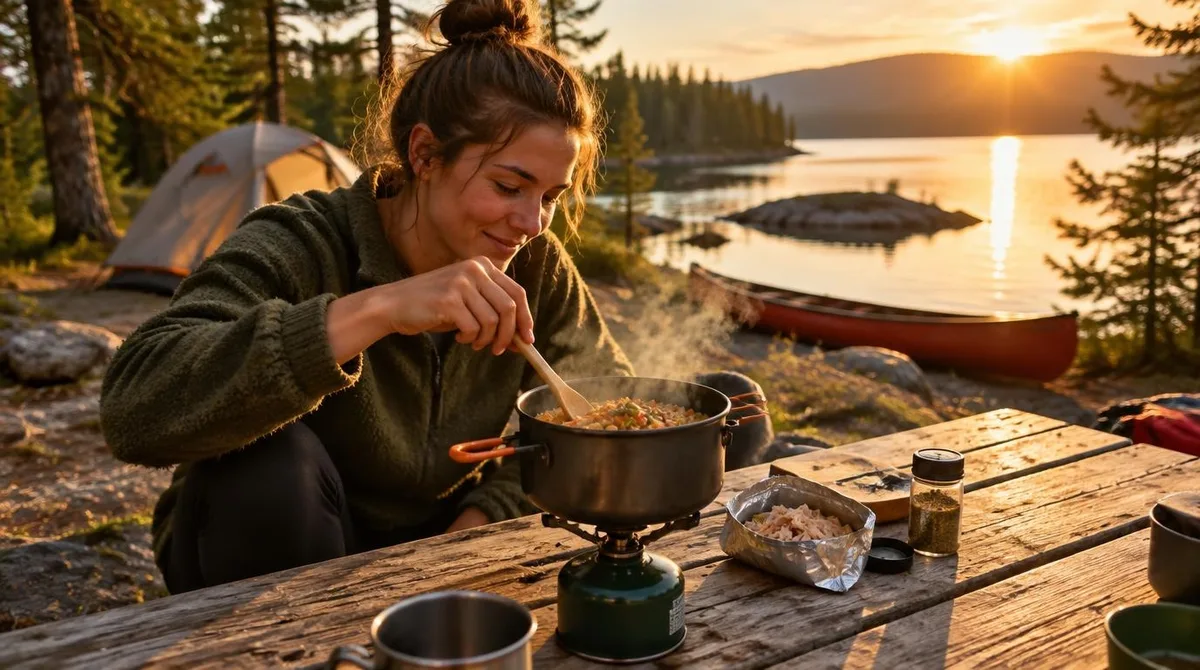
Good one-pot camping meals start at the supermarket, not at the freeze-dried pouch aisle. Build each dinner from a fast starch, a ready protein, and one bold sauce, then finish it in a single pot on a stove that boils a liter in 3.3 minutes, per MSR's own spec sheet. The full formula is below.
The method works from car campgrounds to canoe sites because it carries one pot, one spatula, and one spice kit. Fewer dishes mean faster cleanup, and faster cleanup leaves fewer crumbs for critters. That is the entire gear list. Readers following this should also see Hiking in Extreme Heat: How to Stay Safe Above 90 Degrees.
What Goes Into a Shelf-Stable Meal Formula?
Pick a starch that cooks fast: couscous, instant rice, ramen noodles, or small pasta. Add a ready protein, since pouches of tuna, chicken, or beans need no cooler. Finish with one strong sauce: pesto, peanut, simmer curry, or chili crisp oil. Every part comes off a supermarket shelf and rides out a week of trips. We covered a connected angle in Avalanche Basics Every Winter Hiker Should Know Before Steep Snow.
Balance comes from one fresh item per meal. A hard cheese, a cabbage half, carrots, or citrus all hold up for days without refrigeration, and they turn a pouch dinner into something you would serve at home.
How Do You Cook It in One Pot, Every Time?
Repeat the same five moves:
- 1. Boil the water first, with salt in it. The pot does the work while you chop.
- 2. Cook the starch in that water until just soft, then save some starchy water for the sauce.
- 3. Stir in the protein to warm it through. Pouch proteins only need heat, not cooking.
- 4. Kill the flame, then stir in the sauce and any fat off the heat. Scorched sauce is what turns camp pasta bitter.
- 5. Rest the lid on for two minutes so the starch drinks the sauce.
A canister stove handles a two-liter pot fine. Per MSR's spec sheet for the PocketRocket Deluxe, that model boils a liter in 3.3 minutes and burns 60 minutes per 227-gram canister, enough for a weekend of one-pot dinners for two.
How Do You Keep Cold Ingredients Safe Out There?
Know the danger zone first. It runs from 39 to 145 degrees Fahrenheit, where food-borne bacteria grow readily, and food that stays in it for more than two hours should not be eaten, per the FSIS guidance summarized on Wikipedia.
The CDC's clock is similar for perishables: refrigerate within two hours, or within one hour when the day passes 90 degrees, per its food safety page. At camp that means a hard cooler with ice blocks, food parked in shade, and the lid shut between meals.
What About Cleanup and Food Storage at Night?
Scrape every pot while it is warm, then wipe it with a used paper towel instead of rinsing into the soil. Strain bits into a trash bag, and pack out every scrap. Grey water gets broadcast away from camp where rules allow it.
Then store the night set the same way ranger districts ask for it: food, trash, and scented items sealed together, away from the tent, following the managing agency's rules for your campground. Some sites require canisters or lockers. Conditions change — check with the managing agency before you go.
Conclusion: One Pot, Real Dinner
The whole system fits in a stuff sack and a shopping bag. Fast starch, ready protein, one sauce, five cooking moves, and a cooler clock you respect. Cook the same way on night one and night five, and the trail food never becomes a chore you dread.
- Stove spec: MSR PocketRocket Deluxe, 1 liter boiled in 3.3 minutes, 60-minute burn per 227-g canister, minimum weight 2.9 oz (MSR spec sheet)
- Danger zone: 39 to 145 degrees Fahrenheit; food past two hours there should be discarded (FSIS, summarized on Wikipedia)
- Cooler clock: two hours for perishables, one hour above 90 degrees (CDC)
- Cleanup: scrape warm pots, strain scraps, pack out everything
- Conditions change — check with the managing agency before you go