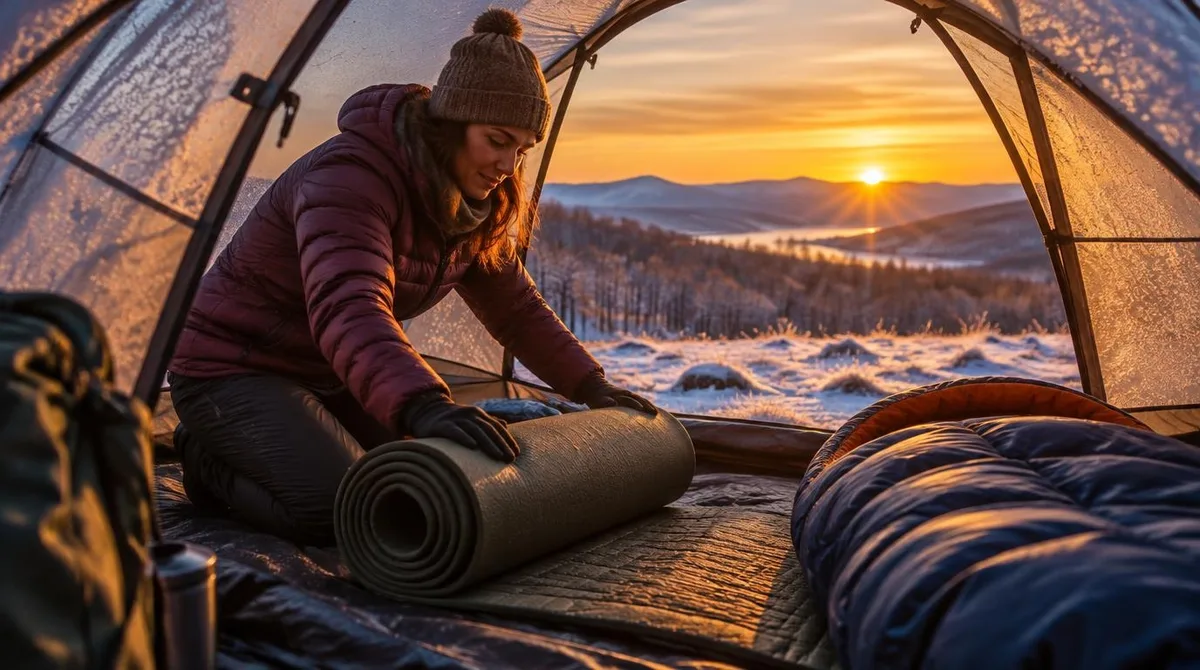
Cold-weather camping gets comfortable when you treat warmth as a system: a pad that blocks ground cold, a bag rated with margin, and dry insulation around your body all night. The floor number comes from Virginia’s park agency: a pad R-value over 5 for any winter camping. The catch is moisture: wet insulation fails, so every habit below protects dryness.
It needs a kit that matches the forecast and a routine that runs before dark. Here is what the ratings mean and the campcraft that turns a cold night into a rested one. We covered a connected angle in One-Pot Camping Meals That Actually Taste Good at Camp.
How Warm Should Your Sleeping Bag Be?
Read the rating, then add margin. Europe normalized bag testing with the EN 13537 standard in 2005, and ISO 23537-1 replaced it in October 2016, per Wikipedia. The lab tests produce four numbers: an upper limit, a comfort rating, a lower limit, and an extreme rating. The extreme number is a survival figure only, not for planning, per Wikipedia.
So plan on the comfort and lower-limit numbers instead. Virginia State Parks puts the field rule simply: pick a bag rated at least 10 degrees colder than the night’s low. A 20 degree night calls for a 10 degree bag.
What Does the Pad R-Value Actually Do?
The ground pulls heat out of you faster than the air does. The pad’s job is to stop that conduction, and the R-value measures how well it works. Per the Virginia Department of Conservation and Recreation, the higher the R-value, the warmer you sleep, and most sources point to a rating over 5 for winter nights. The agency’s blogger reports sleeping well on bare ground with a 5.7 R-value pad.
Treat the pad as the item you never skimp on, as the agency puts it. A great bag on a weak pad still sleeps cold.
Do You Need a Vapor Barrier Liner?
Your body sheds moisture all night, and that vapor migrates into the fill and dulls it. A vapor barrier liner is a non-breathable sack that sits inside the bag and stops that transfer. Rab’s spec page says its hooded liner “prevents moisture from the body getting into the down in your sleeping bag” and positions it for expeditions to extremely cold climates. The liner weighs 6.5 ounces, per Rab.
The trade-off is skin dampness, so the liner earns its weight on multi-night trips where down cannot dry out. On a one-night trip, skip it and air the bag in the morning instead.
Which Campcraft Habits Keep You Warm All Night?
The agency’s field tips read like a ritual. Drink hot fluids through the day. Fill a bottle with boiling water at bedtime and keep it near your core, between your thighs or under an arm, to warm the blood headed for your extremities. Eat fatty food, because your furnace needs slow fuel. Readers following this should also see How to Layer for Winter Day Hikes: A Three-Layer System That Works.
Dedicate dry clothes to sleep. The agency recommends camp-only socks that never leave the tent, plus a wool cap and solid gloves. A four-season shelter helps too: its solid walls trap body heat that a mesh summer tent bleeds into the wind.
How Do You Plan Your First Below-Freezing Night?
- 1. Check the forecast low, then pick a bag rated 10 degrees colder, per Virginia State Parks.
- 2. Set the pad first: R-value over 5 for winter ground, per the same agency.
- 3. Stage dry sleep clothes and camp-only socks before dinner.
- 4. Boil water at bedtime, load a bottle, and slide it to your core.
- 5. Vent the shelter a crack to cut condensation. Winter access changes fast, so check with the managing agency before you go.
Conclusion: Warmth Is a System You Build Before Dark
Comfort below freezing is logistics, not luck. A pad with a real R-value under a bag with margin keeps the ground and the air from teaming up on you. Dry insulation does the insulating, and the hot bottle runs the furnace from inside. Set the system up in daylight and the night takes care of itself.
- Sleep system: winter pad with R-value over 5, per the Virginia Department of Conservation and Recreation, guidance updated December 2025.
- Bag margin: at least 10 degrees below the forecast low, per Virginia State Parks.
- Rating standard: ISO 23537-1, which replaced EN 13537 in October 2016, per Wikipedia; extreme ratings are survival figures only.
- Liner: vapor barrier liners suit multi-night cold trips, per Rab’s spec (6.5 oz).
- Conditions change — check with the managing agency before you go.