Making backcountry water safe comes down to one of three treatment routes: a filter rated fine enough to remove the protozoa and bacteria that cause most wilderness illness, a chemical treatment such as chlorine dioxide that also covers viruses, or boiling — the one method the Centers for Disease Control and Prevention treat as universally reliable, with a rolling boil of one minute at most elevations and three minutes above about 6,500 feet, per CDC guidance on disinfecting water. Filters in the 0.1-to-0.2-micron range, the rating most backpacking manufacturers print on their spec sheets, handle Giardia and bacteria; chemical treatments need longer contact times; and every method works better on water you prefiltered through a bandana or coffee filter.
This guide compares the methods on what they remove, how long they take, and what the manufacturer documents actually promise, then closes with the field habits that keep a treatment system working. It publishes information, not health advice — anyone with a compromised immune system or specific concerns should take the question to a clinician, per the same public-health guidance.
What is actually living in backcountry water?
Three classes of concern, in descending size order. Protozoa such as Giardia and Cryptosporidium are the classic wilderness names — hardy cysts that cause weeks of gastrointestinal misery. Bacteria such as E. coli and Campylobacter ride the same contamination pathways, chiefly water downstream of grazing, camps, and animal traffic. Viruses are the third class, rare in remote US wilderness water but a real consideration near heavy human use and abroad, per CDC water-treatment guidance. The practical translation: a quality filter handles the first two classes; chemical treatment or boiling is what covers the third.
How do you choose between a filter, chemicals, and boiling?
By the trip's shape. Filters are the everyday answer for US backpacking: instant water, no taste penalty, and manufacturer-documented removal of protozoa and bacteria — check the micron rating and the rated volume on the spec sheet, because hollow-fiber filters carry both (ratings in the 0.1-0.2 micron range and rated volumes in the hundreds-to-thousands of liters are typical of current models). Chemical treatment is the backup and the ultralight choice: chlorine dioxide tablets or drops kill protozoa, bacteria, and viruses, but need roughly 30 minutes for most organisms and up to four hours against Cryptosporidium, per EPA-registered product labeling and CDC notes — plan the wait. Boiling is the zero-equipment fallback and the undisputed winner in questionable water: a rolling boil, one minute, three above 6,500 feet, per CDC guidance, at the cost of fuel and cooling time.
| Method | Protozoa | Bacteria | Viruses | Time to drink |
|---|---|---|---|---|
| Filter (0.1-0.2 micron) | Yes | Yes | No | Immediate |
| Chlorine dioxide | Yes (longer contact time) | Yes | Yes | About 30 min; up to 4 h for Crypto |
| Boiling | Yes | Yes | Yes | 1 min boil; 3 min above 6,500 ft |
| UV pen | Yes | Yes | Yes | About 90 seconds per liter, clear water |
What do the manufacturer specs actually tell you?
Four numbers. Micron rating — the pore size that decides what passes; anything at or below about 0.2 microns is the protozoa-and-bacteria class, per the manufacturer documents. Rated volume — how many liters the filter is tested to before flow drops, which is a lifespan estimate, not a hard expiry. Flow rate — the honest number measured under pressure at the start of the filter's life. And the claims themselves: reputable makers test to EPA and NSF-type standards for microbiological purifiers and say so on the spec sheet, per manufacturer documentation — a filter whose packaging claims nothing testable is a straw, not a treatment system. Weight, cartridge replacement cost, and whether the unit backflushes round out the comparison.
How do you pick sources in the field?
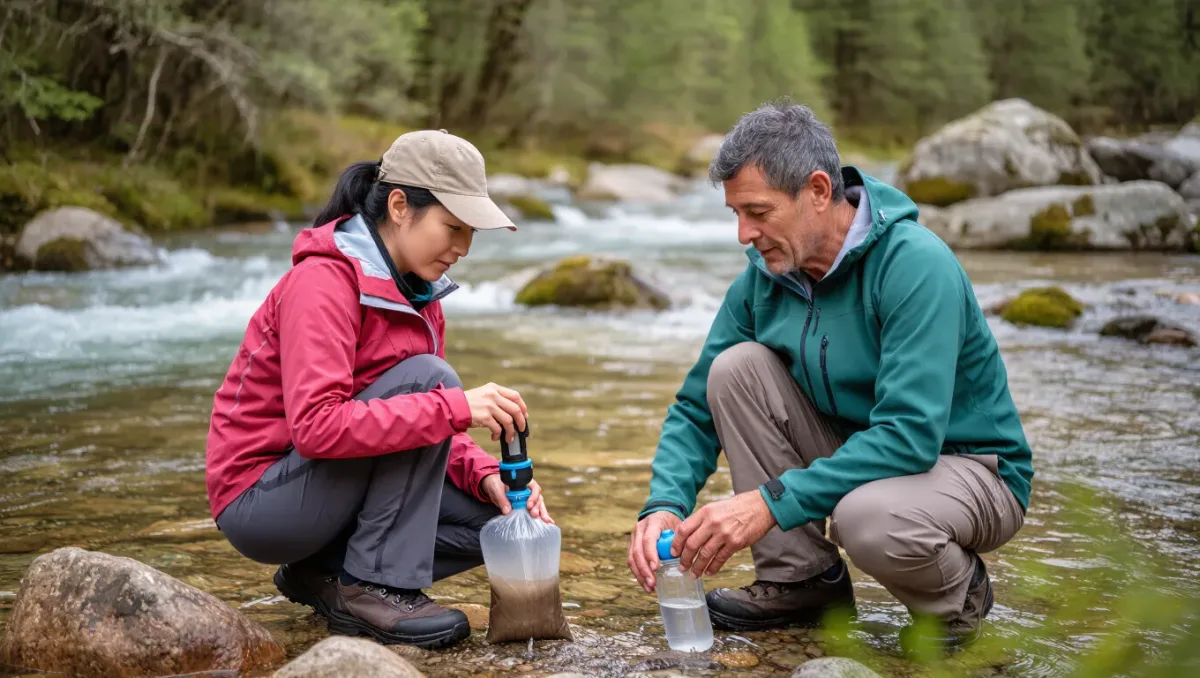
Treatment starts at the source, not the bottle. Choose moving water over stagnant where the choice exists, collect upstream of camps, trails, and stock crossings, and avoid surface scum lines and beaver ponds, per long-standing agency and land-manager guidance for backcountry water. Prefilter cloudy water through cloth before any method — sediment eats filter life and shelters organisms from chemicals and UV. And treat everything from every source: the clear alpine lake that looks drinkable is the classic Giardia story, and the CDC's wilderness-water guidance makes no exception for pristine-looking sources.
Carry a backup: a filter clogs, tablets age out, and stove fuel runs short. The standard kit is a filter plus chemical tablets as the second method — and check conditions with the land agency, because some popular areas post specific water-quality advisories.
How do you keep a filter working all season?
Backflush per the manufacturer's instructions before flow slows rather than after, never let the filter freeze (ice in the hollow fibers cracks them invisibly, and the makers' care documents say to replace a frozen filter), and dry it fully before storage between trips. Keep the intake hose out of the mud with a prefilter screen, and mark treated containers clearly so nobody double-treats or skips a bottle. Tablets carry expiration dates — check them at the start of the season, not at the creek.
Frequently asked questions
Do backcountry filters remove viruses?
Not reliably — pore sizes that filter protozoa and bacteria pass viruses, which is why CDC-style guidance pairs filters with chemical treatment or boiling where viruses are a concern, such as heavily used watersheds or international travel.
Is clear mountain stream water safe untreated?
No, per public-health guidance: Giardia and other organisms live in remote and pristine-looking water alike, carried by wildlife upstream of you. Treat every source, every time.
How long do chemical tablets take?
About 30 minutes for most bacteria, viruses, and Giardia, and up to four hours against Cryptosporidium, per EPA-registered product labeling and CDC notes. Cloudy or cold water extends contact times — read the insert.
Is a UV purifier worth carrying?
For clear water and spare batteries, yes — it treats a liter in about 90 seconds and covers viruses. Its limits are sediment and dead batteries, which is why manufacturers position it alongside, not instead of, a backup method.