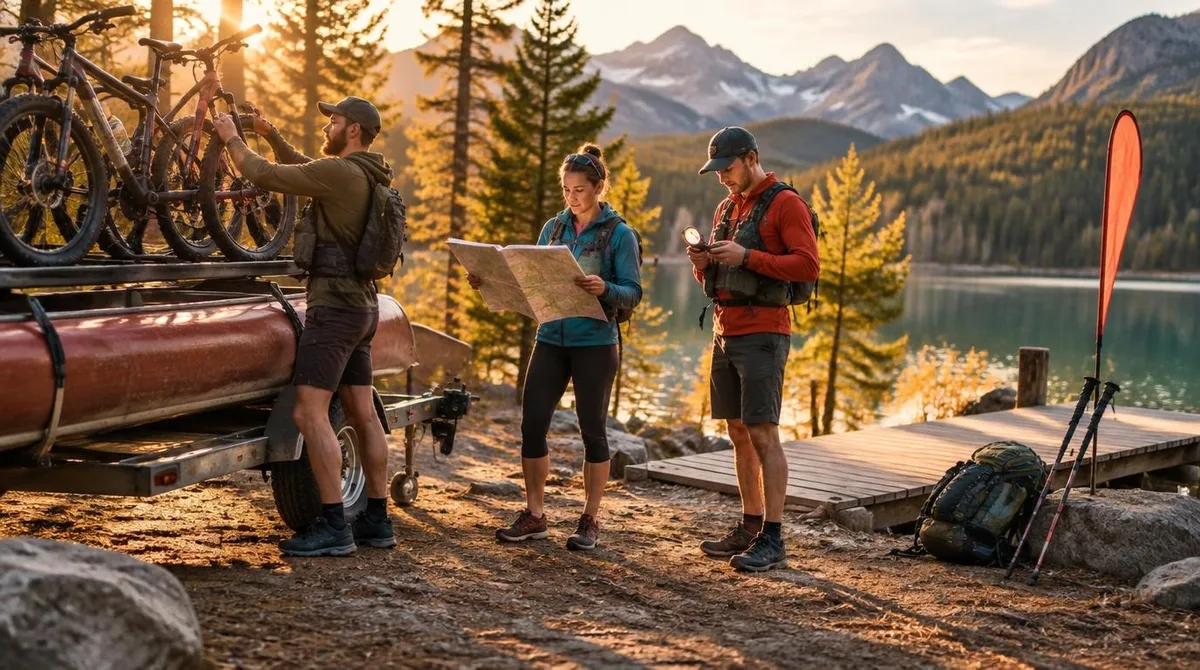
An adventure race sends your team trekking, mountain biking, and paddling between checkpoints the organizers reveal only at the start. You navigate by map and compass, and the clock never stops. New racers usually start with a sprint of three to eight hours, and a single-event USARA membership costs $10 as of April 1, 2026.
This briefing covers the format, the disciplines, the membership paperwork, and the race-day rhythm, so you can pick a debut event and finish it with your team intact. The sport rewards planning over pace. Rookies line up at nearly every race, and the entry logistics are simpler than they look. This connects to our earlier piece, How to Train for a Multi Day Hike: How to Train for Your First Multi-Day Trek.
What Is Adventure Racing, Exactly?
Adventure racing is a navigation-based, off-road team sport. USARA, the national governing body, calls it a scavenger hunt with a clock: the course stays secret until race time, and teams race to as many checkpoints as they can inside a time limit. Checkpoints carry point values, so the ranking follows points first, with time as the tie-breaker. Collect every checkpoint and you clear the course, which separates winners from mere finishers.
Which Disciplines Will Your First Race Include?
Trekking, mountain biking, and paddling anchor most courses, per USARA’s newcomer guide. Race directors layer in whatever the local terrain supports, from climbing and winter sports to stand-up paddleboarding and team challenges. You will not see the full mix until the race brief, and route choice stays yours. Many checkpoints are optional, so teams cover different distances by design. Readers following this should also see What Guide Fees Actually Cover: Breaking Down the Line Items on a Guided Expedition.
How Do Race Formats Differ?
USARA sorts events into three shapes: sprints, one-day races, and multi-day expeditions, per its Race Shapes and Sizes guide. Sprints run roughly three to eight hours, often in local parks, and many are billed as beginner-friendly. Races are timed rather than measured: the limit is fixed, but your distance depends on route choice and how many checkpoints you chase. Pick the shortest option on offer for a debut.
Do You Need a Membership to Enter?
Sanctioned events require it, and the paperwork is small. Annual membership costs $50, and a single-event membership costs $10 for one race of any length, per USARA’s membership page as of April 1, 2026. Membership also bundles accident medical coverage, including $25,000 in excess medical per accident, on top of your own policy. Race entry fees and travel sit outside that.
How Do You Pick Your First Race and Team?
Logistics decide a debut more than fitness does. Work the list in order:
- 1. Filter the USARA-sanctioned race calendar by region and season, then shortlist a sprint-length event within an easy drive.
- 2. Recruit two or three teammates. Premier events ask for mixed-gender teams of three or four, and every team stays together the whole way; adventure racing is not a relay.
- 3. Practice navigation at a local orienteering or rogaine meet, where foot-only courses build map habits without a heavy gear list.
- 4. Read the race brief twice, then sort bikes, boats, and transition bags the night before.
What Happens on Race Day?
Expect a morning check-in, a gear check, and the map handout. You get a planning window, then a mass start. Phones and GPS devices stay out of navigation unless the race director allows them, per USARA rules. Transition areas hold your bike and boat between legs. Watch the clock, because courses close at a fixed cut-off and a team out past it loses rank or an official finish. Pack food you can eat while moving, and agree in advance on when to skip an optional checkpoint. Conditions change, so check with the race director before you go.
Conclusion: Start Short and Trust the Map
Adventure racing welcomes rookies who respect the clock and the map. Pick a sprint, lock in teammates who share your pace, and treat navigation as the core skill. The entry paperwork is a $10 day membership at the April 2026 rate, and the learning curve is half the draw. Finish one, and the season calendar does the rest.
- Format: checkpoint score race on an unmarked course
- Core disciplines: trekking, mountain biking, paddling
- First-race length: three to eight hours (sprint), per USARA
- Entry cost: $10 single-event membership as of April 1, 2026
- Governing body: USARA